
 Spokānda

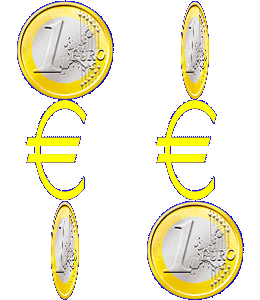
General notification to Spocanians travelling on the European continent
January the 1st, 2002, will see the abolishment of the national
currencies of Austria, Belgium, Finland, France, Germany, Greece, Ireland, Italy, Luxemburg, the Netherlands, Portugal and Spain. From
that time on, one will start paying with the euro in these EU
countries. For Spocanian tourists the world abroad will perhaps
become a little drabber then, a little less interesting. No
longer will we be baffled by large quantities of Italian liras,
incomprehensible texts on Portuguese escudos, or by the fact that
the Dutch Queen's head is severed lengthwise. The confusion
between French and Belgian francs will also be a thing of the
past. Paying in above-mentioned countries will thus have become
much easier. All over Europe, one will be rid of the bother of
changing one's currency at every border crossing. Spocanian banks
will no longer need to stock a wide range of European currencies
for the benefit of those travelling abroad. You will be able to
change your hercos to euros, which any Spocanian bank can change
back for you. The situation will be more convenient, reliable and
efficient.
The National Bank of Spocania will do its utmost to maintain the
exchange rate between euro and herco at the present level:
1 euro = 0.94 herco, and 1 herco = 1.06 euro.
The aim of the European Bank and the Bank of Spocania will be to always keep fluctuations in the exchange rate under 3% of the actual rate. In this respect, Spocania follows the strategy established for the members of the European Union who (as yet) have not replaced their currency by the euro.
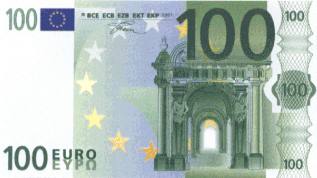
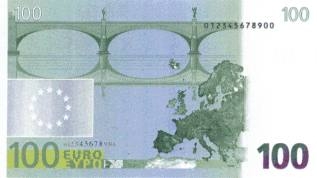
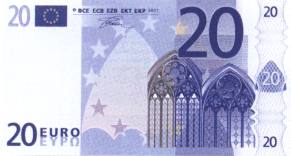
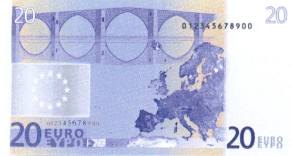
Notes There are 7 euro notes. In different colours and sizes they are denominated in 500, 200, 100, 50, 20, 10 and 5 euros. The designs are symbolic for Europe's architectural heritage. They do not represent any existing monuments. Windows and gateways dominate the front side of each banknote as symbols of the spirit of openness and cooperation in the EU. The reverse side of each banknote features a bridge from a particular age, a metaphor for communication among the people of Europe and between Europe and the rest of the world. Final designs were announced in December 1996 at the Dublin, European Council. All notes will carry advanced security features.
Coins There are 8 euro coins denominated in 2 and 1 euros, then 50, 20, 10, 5, 2 and 1 cents. Every euro coin will carry a common European face. On the obverse, each Member State will decorate the coins with their own motifs. No matter which motif is on the coins they can be used anywhere inside the 12 Member States. For example, a French citizen will be able to buy a hot dog in Berlin using a euro coin carrying the imprint of the King of Spain.The common European face of the coins represents a map of the European Union against a background of transverse lines to which are attached the stars of the European flag. The 1,2 and 5 cent coins put emphasis on Europe's place in the world while the 10, 20 and 50 present the Union as a gathering of nations. The 1 and 2 euro coins depict Europe without frontiers. Final designs were agreed at the European Council meeting in Amsterdam in June 1997.
Sign The graphic symbol for the euro looks like an E with two clearly marked, horizontal parallel lines across it. It was inspired by the Greek letter epsilon, in reference to the cradle of European civilisation and to the first letter of the word 'Europe'. The parallel lines represent the stability of the euro. The official abbreviation for the euro is 'EUR'. It has been registered with the International Standards Organisation (ISO), and will be used for all business, financial and commercial purposes, just as the terms 'FRF' (French franc), 'DEM' (Deutschmark), 'GBP' (pound sterling) and 'BEF' (Belgian franc) are used today.
| €1 = 100 € cent | 
|  |
|---|---|---|
| Austria | 
|  |
| Belgium | 
|  |
| Finland | 
|  |
| France | 
|  |
| Germany | 
|  |
| Greece | 
|  |
| Ireland | 
|  |
| Italy | 
|  |
| Luxemburg | 
|  |
| Netherlands | 
|  |
| Portugal | 
|  |
| Spain | 
|  |
Spooksoliy Benc - Mennofiss - Hirdo